
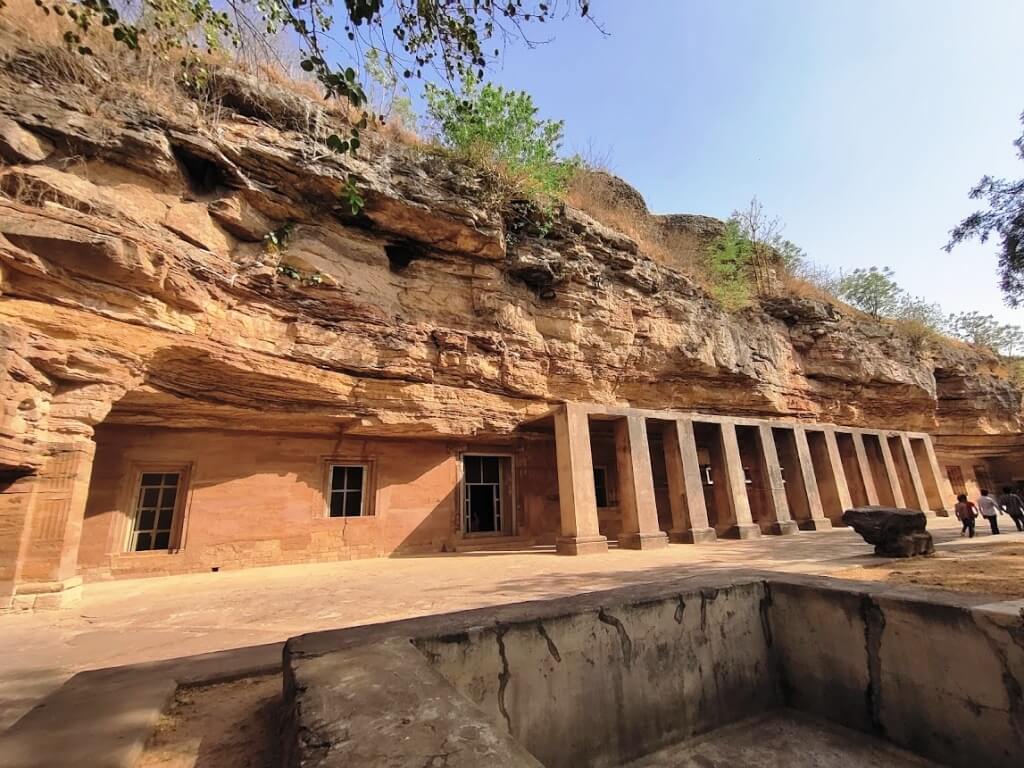
In a fold of the Vindhyas above the Baghani river, nine chambers were cut into the rock between the fourth and sixth centuries as Buddhist monasteries and halls of prayer. Five survive. Their walls were finished in tempera upon a mud plaster the colour of the hillside itself, and what was painted there belongs to the golden age of Indian classical art.
The fourth cave — the Rang Mahal, the Palace of Colours held the finest of it. Its bodhisattva Padmapani is believed by scholars to have preceded the celebrated Padmapani of Ajanta, and what survives of the processions, the princes and the musicians is worldly rather than devotional: court life, closely observed. The second cave, long called the Pandava Cave, is the best preserved of those that remain, with a colonnaded hall and a stupa at its heart. Twenty-one panels were lifted from the walls a century ago for their preservation, and are shown today at the museum beside the caves and at Gwalior.
Bagh is quieter than Ajanta and very nearly unvisited, which for a certain kind of traveller is the whole of its appeal.
Bagh is quieter than Ajanta and very nearly unvisited, which for a certain kind of traveller is the whole of its appeal. Carved into the sandstone cliffs of the Vindhyas along the quiet Baghani River in Madhya Pradesh, this set of 5th-century Buddhist monasteries offers a rare, solitary encounter with antiquity.
Where Ajanta draws bustling crowds, Bagh offers undisturbed stillness. Of the original nine rock-cut viharas, five survive, carrying the muted ghosts of vibrant Gupta-era tempera murals that once rivalled the finest classical art of ancient India. Stepping into Cave 4—the Rang Mahal, or Palace of Colours—feels like discovering a forgotten kingdom. The air inside is cool, scented with damp stone and age, where sunlight filters through ancient doorways onto grand carved pillars and shadow-draped statues.

The village lends its name to something else besides. Bagh print, block printing in vegetable dye upon cloth washed in the river, worked in indigo, madder and iron has been practised here for generations, and the printing families receive visitors at their workshops, where the carved blocks, the dye vats and the drying grounds may all be seen and the cloth bought directly. Taken together with the weavers of Maheshwar, the two make a considered study of what this district still makes by hand.
Valid credit card details are required to guarantee the booking. Validation charge may appear on guest credit card statement
Please note that a change in the length or dates of your reservation may result in a rate change
Hotel's standard cancellation policy will be applicable. Retention would be charged as per the hotel policy.
Taxes extra as applicable
The offer is applicable at participating hotels on select days of the week only and is subject to availability.